
5 Study Abroad Scholarships That Don't Require Repayment (2025-2026 Comparison)
If you want to fund your study abroad without taking on debt, choosing the right scholarship means looking beyond the award amount. You need to consider who qualifies, which academic path fits, and when to start preparing. This article compares major grant-type scholarships and related programs available for 2025-2026 in Japan -- including JASSO (Japan Student Services Organization), Tobitate! Study Abroad JAPAN, and the Murata Overseas Scholarship Foundation -- breaking down the "sweet spots," backward-planning timelines, and required documents for each target group (high school students, undergraduates, and degree-seeking students). Note that the dates and application examples cited here are based on publicly available information as of 2025-2026. Always confirm the latest guidelines on each program's official page.
Two Main Types of Study Abroad Scholarships -- Start by Understanding What "No Repayment Required" Actually Means
Grant-Type vs. Loan-Type
Study abroad scholarships in Japan fall into two broad categories: grant-type (給付型) and loan-type (貸与型). Under JASSO's classification, grant-type means "no repayment required," while loan-type means "repayment is required." Since most study abroad-related programs are grant-type, anyone searching for "scholarships that don't require repayment" is essentially looking for grant-type programs.
That said, "no repayment required" can create a misleading impression -- as though it's simply free money that anyone can receive. From what our editorial team has observed in advising students, a surprisingly large number of applicants operate under this assumption, and it leads to preventable failures. In practice, people get rejected due to mismatches between their profile and the program: applying to a program with academic requirements they don't meet, assuming they can apply individually when the program requires school-based submission, or submitting a short-term study plan to a degree-seeking program.
In this article, we separate "grant-type programs specifically for studying abroad" from "grants and tuition waivers for domestic enrollment that free up funds for study abroad." For example, JASSO's Overseas Study Support Program (Undergraduate Degree Type) is the former -- a grant specifically for students pursuing a bachelor's degree at a foreign university. Meanwhile, Japan's Higher Education Enrollment Support System (修学支援新制度) isn't study abroad-specific, but by reducing domestic tuition and enrollment fee burdens, it helps students redirect funds toward study abroad preparation.
As a starting point for finding programs, JASSO's "Scholarships for Study Abroad" portal on their overseas study information site provides a solid overview. From there, filtering by "grant-type (receive) vs. loan-type (borrow)" makes it easier to narrow candidates to no-repayment programs.
Who Runs These Programs
Study abroad scholarships may look similar by name, but the sponsoring organization changes everything about how they work. The main sponsors are: the national government, independent administrative agencies, local governments, schools (universities and high schools), and private foundations.
Among government and agency-run programs, JASSO and Tobitate! Study Abroad JAPAN are the flagship examples. JASSO's Overseas Study Support Program (Undergraduate Degree Type) is a grant for students pursuing a bachelor's degree at a foreign university, with application guidelines typically published around late July to August each year. However, application deadlines and entry periods shift annually (for instance, the 2026 cycle had an entry period of September 1-25, 2025, closing at 1:00 PM). Always verify the exact dates in the official guidelines for the relevant year.
Even among publicly funded programs, Tobitate! Study Abroad JAPAN operates differently. For its high school student track, applications go through the student's enrolled school -- it's not a program where students or parents apply directly. The 11th cohort also required return to Japan by March 31, 2027, meaning students need to design their study period around the program's requirements. Simply finding a good program isn't enough; aligning your application route and study plan with the program's structure is critical.
Local government grants vary enormously in both amount and eligibility. Through Tobitate's scholarship search tool, you can find programs ranging from grants capped at 500,000 yen (~$3,300 USD) to European programs offering 1,217.33 euros per month plus a 400-euro housing supplement. However, these often filter by residence, age, school type, and destination region, so a one-size-fits-all search approach won't work.
Programs run by universities and high schools tend to pair well with exchange or approved study abroad arrangements. School nomination or school-based submission is usually required, and internal deadlines often come before the public application deadline. As noted above, the earlier you start planning backward, the more options you'll have.
Private foundations are where you'll find programs with strict requirements but generous funding. The Murata Overseas Scholarship Foundation, for example, lists application examples including a 500,000 yen (~$3,300 USD) preparation grant, tuition up to US$26,000/year, and living expenses of US$24,000/year -- adding up to roughly US$50,000 per year in total support. The living expenses alone work out to about US$2,000/month, providing a solid financial foundation during your studies. The Keidanren International Education Exchange Foundation (経団連国際教育交流財団) has also posted examples around 5 million yen (~$33,000 USD) per year through university channels. These programs are highly attractive, but their nomination routes and eligibility categories are detailed enough that many applicants get filtered out at the information-gathering stage.
The Reality: "No Repayment" Still Comes with Conditions and Obligations
Even with no-repayment scholarships, you're not receiving money with zero strings attached. In fact, pre-award conditions and post-award obligations are integral parts of every program.
Common pre-award conditions include academic performance, language proficiency, destination and purpose of study, Japanese citizenship or enrollment status, age, and household income criteria. Some programs like JASSO's Undergraduate Degree Type require that you're pursuing a bachelor's degree at a foreign university, while others like Tobitate evaluate the originality of your research theme and study plan. For school-nomination programs, clearing internal selection is itself a major hurdle.
Post-award obligations may include submitting reports, attending training sessions, providing activity updates, and meeting return deadlines. The return deadline in Tobitate's high school track is a prime example, and some local government grants also require post-return presentations. Repayment isn't required, but the grant only holds if you fulfill the program's rules -- that's the more accurate way to understand grant-type scholarships.
💡 Tip
With study abroad scholarships, applying to multiple programs is usually allowed, but receiving multiple grants simultaneously often isn't. School advisories frequently highlight this point. The typical approach is to apply to several programs, then choose one after receiving offers.
This distinction between multiple applications and multiple awards is an easily overlooked detail. Being able to apply to many programs doesn't mean you can stack all the awards. Some programs, like the Sasakawa Scholarship (笹川奨学金), adjust their disbursement based on whether you're receiving other grant-type scholarships. Conversely, there are occasional exceptions that do allow concurrent receipt. The safest assumption is "multiple applications are fine, but concurrent awards usually aren't."
When searching for programs, start with JASSO's comprehensive portal to grasp the overall landscape, then use grant-type filters to build your shortlist. From there, check whether each program requires school-based or individual submission, whether your academic path matches the eligibility criteria, and what post-award obligations apply. This approach prevents you from being swayed by the phrase "no repayment required" alone.
5 No-Repayment Study Abroad Scholarships (Major Programs for 2025-2026)
These five programs include a mix of "programs that directly fund your study abroad" and "programs that reduce domestic tuition costs to free up funds for study abroad." Distinguishing between the two makes it much easier to identify which ones fit your situation. In high schools, the faculty office is the typical starting point for school-based applications; in universities, it's the study abroad center or international affairs office. Our editorial team has repeatedly observed that students who visit these offices first are the ones who learn about internal deadlines and nomination requirements early enough to gain an advantage.
Here's a quick breakdown of how the programs differ: JASSO is the standard choice for students pursuing a bachelor's degree at a foreign university, Tobitate's high school track is for high school students submitting study plans through their school, the Higher Education Enrollment Support System reduces domestic tuition to strengthen overall financial planning, the Murata Overseas Scholarship Foundation is a leading private foundation example covering living expenses, tuition, and travel costs, and the Keidanren International Education Exchange Foundation represents nomination-based programs with potential for large grants, primarily for graduate students.
JASSO Overseas Study Support Program (Undergraduate Degree Type): For Students Pursuing a Bachelor's Degree Abroad
JASSO's "Overseas Study Support Program (Undergraduate Degree Type)" is the representative grant-type scholarship for anyone considering earning a bachelor's degree at a foreign university. The target is primarily students enrolling directly at overseas universities to pursue an undergraduate degree -- not for short-term or exchange programs. The application route is individual submission, which means you can act on your own without waiting for a school nomination.
The timeline is also relatively predictable. Application guidelines are typically published around late July to August, and the 2026 cycle page showed an entry period of September 1-25, 2025 (closing at 1:00 PM). The 2026 cycle targets students beginning their studies between April 2026 and March 2027. Since this overlaps with the fall application season for overseas universities, many applicants run this process in parallel with their university applications.
The support is grant-type, but the most important factor is whether the program aligns with your path -- pursuing a degree at a foreign university. Rather than fixating on exact award amounts, first confirm that your academic trajectory matches. This program suits people who are preparing for overseas university enrollment from the start, not those going on exchange from a Japanese university. It pairs well with high school seniors, graduates aiming for overseas admission, and students weighing domestic versus foreign enrollment but with a foreign degree as their primary target.
海外留学支援制度(学部学位取得型)
独立行政法人日本学生支援機構(JASSO)の公式ホームページです。
www.jasso.go.jpTobitate! Study Abroad JAPAN (High School Student Track): School-Based Application
Tobitate! Study Abroad JAPAN's high school student track is a grant-type program where high school students apply through their enrolled school. The application route is critical here -- this is not an individual application program; submission through your high school is the standard process. The official preparation guide for the 2026 cycle (11th cohort) makes this school-based requirement explicit.
The target is high school students, and it's best understood separately from the university/graduate student tracks. As a timeline reference, the 11th cohort's first application window runs from December 3, 2025 to January 22, 2026. Additionally, the program FAQ specifies a requirement to return to Japan by March 31, 2027, meaning your study period must be designed to fit the program's parameters.
The support is grant-based study abroad funding, and a hallmark of Tobitate is the emphasis on the content and exploratory nature of your study plan. For the high school track, students who can articulate why that country and why that theme tend to be stronger candidates than those who simply want to "go abroad." This program suits high school students who can develop their plan collaboratively with their teachers and those who can connect extracurricular or inquiry-based activities to their study abroad theme. Students who start consulting with teachers early get a clearer picture of who to involve and what order to prepare documents in, which ultimately gives them more breathing room.
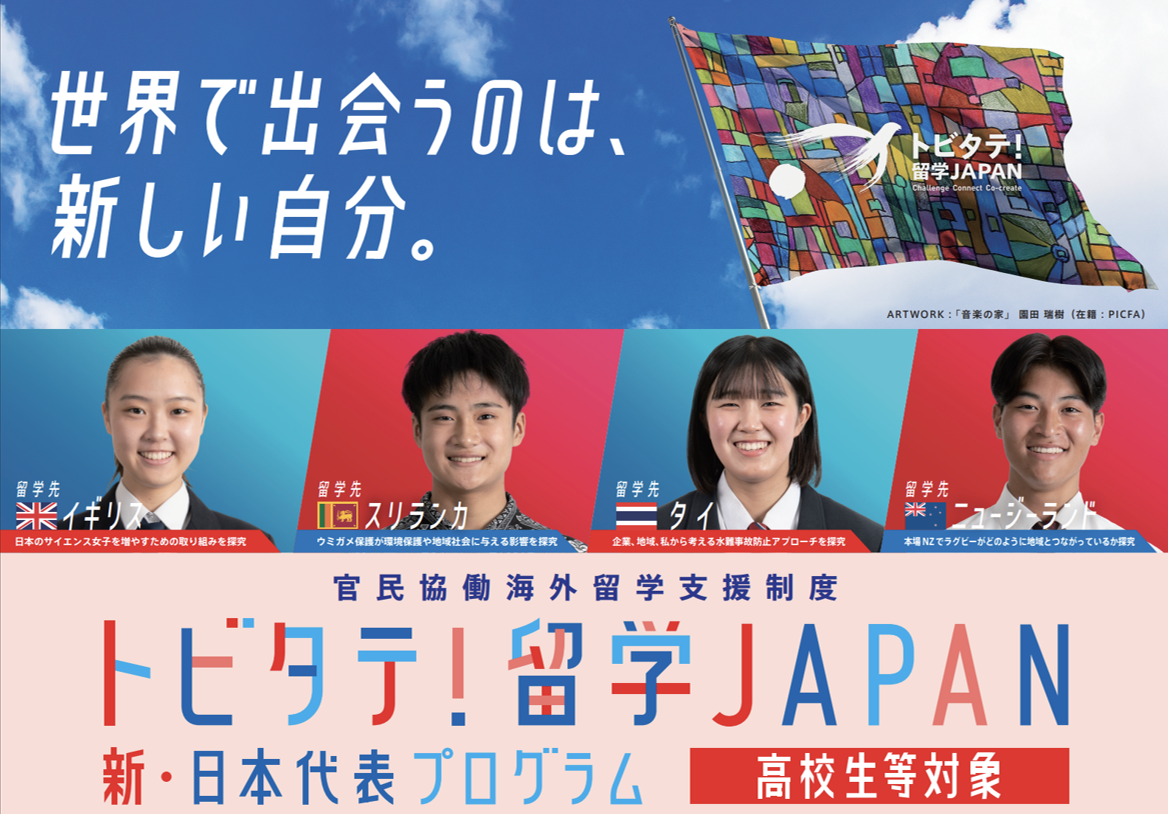
【高校生等対象】2026年度(第11期)応募への準備お役立ち情報 ~新・日本代表プログラム~ | ニュース | トビタテ!留学JAPAN | 文部科学省
トビタテ!留学JAPAN新・日本代表プログラム【高校生等対象】2026年度(第11期)応募の準備に関する資料や説明会情報などをまとめたページです。
tobitate-mext.jasso.go.jpHigher Education Enrollment Support System (Including Multi-Child Households): Reducing Domestic Tuition to Support Financial Planning
The Higher Education Enrollment Support System (高等教育の修学支援新制度) is, strictly speaking, not a study abroad-specific scholarship. However, it's a program you can't afford to overlook when planning study abroad finances. Its role is reducing the fixed financial burden of domestic university, junior college, technical college, or vocational school enrollment through tuition/enrollment fee waivers and grant-type support. Japan's Ministry of Education (MEXT) has outlined that starting from the 2025 academic year, students from multi-child households will receive tuition and enrollment fee reductions up to a set amount regardless of income restrictions.
The target is primarily university students, junior college students, technical college students, and vocational school students -- both incoming and currently enrolled. The application route is generally school-based, handled through campus offices alongside JASSO-related procedures. For the 2025 multi-child household support, some guidance indicates it's available only through in-enrollment applications, suggesting the process moves through university offices from spring onward.
The support doesn't directly cover overseas tuition or travel costs -- it reduces your domestic tuition burden. This makes it best suited for students who "enroll at a domestic university first, then pursue exchange or approved study abroad programs." When domestic tuition waivers reduce your annual fixed costs, that freed-up money can go toward passport fees, language tests, airfare, and initial living expenses abroad. It may not be glamorous, but as a tool for keeping your overall financial plan stable, it's remarkably practical.
💡 Tip
For school-based programs, internal deadlines often arrive before the public application deadline. Whether in high school (faculty office) or university (study abroad center or student affairs), the students who make contact first are the ones who discover programs more easily.

高等教育の修学支援新制度:文部科学省
www.mext.go.jpMurata Overseas Scholarship Foundation (Application Example): Generous Support Covering Living Expenses, Tuition, and Travel
Among private foundations, the Murata Overseas Scholarship Foundation (公益財団法人 村田海外留学奨学会) stands out for the depth of its support. Application examples show a preparation grant of 500,000 yen (~$3,300 USD), tuition up to US$26,000/year, and living expenses of US$24,000/year, though some sources list living expenses as a monthly figure (e.g., US$2,500/month), creating discrepancies in annual calculations. Because of these variations across sources, we note that these are presented as "application examples." Always verify the final award amounts and units in the official application guidelines PDF on the Murata Scholarship Foundation's website (e.g., refer to the guidelines PDF at https://www.muratec.jp/).
As a timeline reference, the open-application overseas university scholarship (acceptance-based) listed dates of December 18, 2025 to January 20, 2026 at 5:00 PM. Applications cluster around the new year, making this program a good fit for students whose overseas university admission decisions or application status become clear from autumn onward. It suits students seriously pursuing degree-seeking study in the US or UK who need comprehensive support covering not just tuition but living expenses and travel costs. Among private foundations, this is the kind of program where getting accepted can stabilize your entire financial plan at once.
Keidanren International Education Exchange Foundation and Other Private Foundations (Examples): Potential for Large Grants up to 5 Million Yen (~$33,000 USD) Per Year
The Keidanren International Education Exchange Foundation (公益財団法人 経団連国際教育交流財団) and similar private foundations are particularly strong options for graduate students. Eligibility varies by program, but representative examples found through university channels primarily target Japanese graduate students. The application route is typically a nomination system through the student's university, with internal selection preceding foundation-level review.
Award amounts differ by program name. University channel examples show grants of 5 million yen (~$33,000 USD) per year, while a separate Keidanren-affiliated program lists 2 million yen (~$13,000 USD) per year. Lumping these together as "Keidanren-related" can be misleading. In this article, we position this as a domain where large annual grants of ~$33,000 USD exist as representative examples. These programs can cover tuition, living expenses, and research costs at a high level, but eligibility and available slots are quite limited.
The practical timing point is that university internal nomination calls come before the foundation's public timeline. This suits students planning specialized research-oriented study abroad at the graduate level who can coordinate with their university's international affairs or graduate school office. These programs tend to favor graduate students over undergraduates and long-term research stays over short-term language programs.
Beyond the Keidanren Foundation, private foundations vary enormously in award amounts and eligibility. To broaden your search, Tobitate's scholarship search tool covers local government and private organization programs as well, turning up everything from local government grants capped at 500,000 yen (~$3,300 USD) to European programs offering 1,217.33 euros per month plus a 400-euro housing supplement. Students targeting large grants especially need to compare university nomination slots and private foundation options in parallel.
留学奨学金検索 | トビタテ!留学JAPAN | 文部科学省
留学に利用できる奨学金情報を発信しています。文部科学省が展開する「トビタテ!留学JAPAN」は、日本の若者の海外留学への気運を醸成する官民協働の留学促進キャンペーンです。
tobitate-mext.jasso.go.jpComparing All 5 Programs: Differences in Eligibility, Award Content, Application Timing, and Submission Route
Listing program names side by side doesn't help much on its own, so here we organize the comparison to distinguish between "programs that directly fund study abroad" and "programs that reduce domestic tuition costs." In our advisory experience, confusing these two categories was a frequent source of misunderstanding -- students expected travel cost coverage but actually received a domestic tuition waiver. The right program depends not just on the award amount but on whether it matches your academic path, whether you can apply individually, whether school-based submission is required, and when you need to have everything ready.
Quick Comparison Table
Here's the full side-by-side overview.
| Program | Support Type | Target | Application Route | What's Covered | Award Estimate (Application Examples) | Application Period (Year/Month) | Notes / Preparation Burden |
|---|---|---|---|---|---|---|---|
| JASSO Overseas Study Support Program (Undergraduate Degree Type) | Direct grant for study abroad | Students pursuing a bachelor's degree at a foreign university | Individual application | Primarily a support framework for overall study abroad costs | Defined per year on the official page | 2026 cycle entry: Sep 1-25, 2025 (1:00 PM); guidelines published late Jul-Aug | Designed for degree-seeking study with detailed requirements. Aligning language scores, statement of purpose, and application documents takes significant time |
| Tobitate! Study Abroad JAPAN (High School Student Track) | Direct grant for study abroad | High school students | Through enrolled high school | Costs for executing the study plan | Defined per cohort/year | 11th cohort first window: Dec 3, 2025 - Jan 22, 2026 | Coherence between research theme and study plan is critical. School-based route means internal preparation starts early |
| Higher Education Enrollment Support System (incl. multi-child households) | Domestic tuition waiver/grant | Students enrolling in university, junior college, technical college, vocational school | School-based | Domestic tuition waivers and grant-type support | Determined by program category | Operates on an annual basis with in-enrollment applications | Doesn't directly fund study abroad, but reducing domestic fixed costs makes it easier to fund exchange or approved study abroad programs |
| Murata Overseas Scholarship Foundation | Direct grant for study abroad | Students pursuing degrees at overseas universities/graduate schools | Individual application / school nomination | Examples include tuition, living expenses, preparation grant, miscellaneous costs, return travel | Preparation: 500,000 yen (~$3,300 USD), Tuition: up to US$26,000/yr, Living: US$24,000/yr (some sources list US$2,500/mo) | Open application (acceptance-based) example: Dec 18, 2025 - Jan 20, 2026 (5:00 PM) | Very generous support. Age requirements and study format conditions in examples are relatively strict; document and interview preparation demands are high |
| Private/Foundation Programs (Keidanren, Sasakawa, JEES, etc.) | Direct grant for study abroad and varies significantly by program | Undergraduates, graduate students, overseas enrollees -- varies by program | Mostly school nomination / some individual applications | Tuition, living expenses, travel, research costs -- varies by program | Keidanren: examples of 5M yen (~$33K USD)/yr and 2M yen (~$13K USD)/yr. Sasakawa: actual tuition + US$15,000/yr (US) or £11,000/yr (UK). JEES: varies by program | Autumn-winter or spring -- varies widely | Large amounts but eligibility, designated universities, nomination requirements, and concurrent-award rules differ significantly by program. Tobitate's scholarship search and JASSO's scholarship search are useful starting points |
The key distinction in this table: JASSO's Undergraduate Degree Type and the Murata Foundation are "programs that directly support overseas enrollment," while the Higher Education Enrollment Support System "reduces domestic tuition costs." Both benefit household finances, but the money flows in entirely different ways. A student targeting direct study abroad funding who only looks at the Enrollment Support System will end up with a skewed budget estimate.
Meanwhile, the practical reality is that your top choice shifts depending on your academic stage: Tobitate for high school students, JASSO Undergraduate Degree Type for undergraduates seriously pursuing a foreign degree, Murata for comprehensive tuition-plus-living-expense coverage, and Keidanren/JEES programs for graduate students in specialized research. The Sasakawa Scholarship, with its actual-tuition-reimbursement model, doesn't show up well in simple "how much per month" comparisons, but for US-bound students the combination of fixed living expense disbursements plus actual tuition coverage makes it quite powerful for high-tuition pathways.
From our editorial team's observations, JASSO-focused applicants typically orient around the September deadline, which means taking a language test at least once before summer is the realistic approach. Even if the score isn't perfect, having one attempt on record makes it much easier to structure the rest of your application timeline. Requesting recommendation letters also went smoother for students who approached teachers before summer break, when schedules get heavier. While it's difficult to compare competitiveness across programs in a single statement, the preparation burden varies considerably. School-nomination programs have early internal deadlines, while individual-application programs place the weight of managing language scores, statements of purpose, and enrollment plans squarely on the applicant.
💡 Tip
When the comparison gets overwhelming, use these three questions to filter: "Am I a high school student, undergraduate, or graduate student?" "Do I need direct funding for going abroad, or do I want to reduce domestic tuition?" "Can I proceed with individual applications, or do I need a school-based route?" These three cuts narrow the field dramatically.
Private and foundation programs differ substantially among "Keidanren," "Sasakawa," and "JEES." Keidanren-affiliated programs lean toward graduate students through university nomination channels. Sasakawa targets undergraduates headed to designated universities in the US and UK with a robust support structure. JEES is better understood as a collection of named scholarships under one umbrella rather than a single large program, and each requires individual verification. Beyond Tobitate's scholarship search, JASSO's study abroad scholarship page and private foundation search portals are useful tools for building your candidate list.
2025-2026 Application Timeline Calendar
Since each program requires different documents, what matters isn't just the deadline but how far in advance you need to start working backward. Here's a simplified timeline of the major milestones for 2025-2026.
| Period | Programs in Motion | What Becomes Clear |
|---|---|---|
| Late Jul - Aug 2025 | JASSO Undergraduate Degree Type | Application guidelines finalized; eligibility, required documents, and deadlines become concrete |
| Sep 2025 | JASSO Undergraduate Degree Type | Entry period: Sep 1-25 (1:00 PM). Summer language prep and recommendation requests pay off directly here |
| Dec 2025 | Tobitate high school track, Murata Foundation, open-application private foundations | Tobitate 11th cohort first window opens Dec 3. Murata example also opens Dec 18 |
| Jan 2026 | Tobitate high school track, Murata Foundation | Tobitate closes Jan 22; Murata example closes Jan 20 at 5:00 PM. Deadlines cluster right after the new year |
| Spring 2026 onward | Higher Education Enrollment Support System (incl. multi-child households), school-nomination foundations | In-enrollment applications after domestic enrollment and university-based nomination scholarships become active |
This timeline reveals two peaks: JASSO runs summer through early fall, while the Tobitate high school track and Murata run winter through the new year. So even though everyone is "preparing in the 2025 academic year," JASSO applicants need their core documents ready by summer, while those targeting winter private foundation deadlines can use autumn to solidify their admission status and study plans.
The backward-planning approach also differs by program. For JASSO's Undergraduate Degree Type, students who front-load language tests, statements of purpose, and destination research do better than those who try to cram everything after guidelines are published in late July. For the Tobitate high school track, the process centers on building a study plan through school, so the key question by autumn is whether you can articulate the connection between your inquiry theme and your destination. Murata and other private foundations involve refining documents alongside year-end deadlines while managing overseas university application and admission status in parallel. For university-nomination programs, internal calls come even earlier.
Looking at the deadline calendar, it might seem like the larger grants are "last-minute battles," but in practice it's the opposite. The bigger the grant, the more components are required -- language scores, recommendations, statements of purpose, study plans, and sometimes interview preparation. The advantage goes to students who started moving not 2-3 months before the deadline, but in the semester before that. Despite differences across programs, viewing JASSO as the autumn peak and Tobitate/Murata as the winter peak makes the 2025-2026 planning landscape much clearer.
From Research to Application: 5 Steps to Winning a Scholarship
Rather than compiling a long list of program names, breaking the application process into five steps works better in practice. Among the students our team has advised, those who stalled tended to spend too much time deliberating "which program is best" while putting off the application route and document preparation sequence. Locking in your study abroad type and point of contact first immediately narrows both the guidelines you need to read and the documents you need to prepare.
Step 1: Decide Your Study Abroad Type (Exchange, Degree-Seeking, or Short-Term)
The first decision isn't "where do I want to go" but what type of study abroad am I pursuing. Whether it's exchange, degree-seeking at a foreign university, or short-term training/inquiry-based -- the layer of available scholarships shifts significantly depending on this choice. JASSO's Undergraduate Degree Type targets students pursuing a bachelor's at a foreign university. Tobitate is designed around study plans integrated with school-based learning and inquiry. The Murata Foundation supports degree-seeking study generously but excludes exchange programs and stays under one year.
Without clarity here, reading application guidelines becomes difficult because you can't tell whether you actually qualify. Conversely, if you know it's exchange, focus on programs through your university's international office; if it's degree-seeking, prioritize JASSO and private foundations; if it's short-term, broaden your scope to include local government grants and school-specific funding.
Students spanning academic years should also check at this stage whether a program uses in-enrollment applications or advance reservation applications. For instance, whether you're a high school student planning finances through college enrollment or an enrolled university student funding study abroad during your degree changes which office you approach. Programs that reduce domestic tuition to create study abroad funds work best when considered alongside direct study abroad grants.
Step 2: Confirm Whether Submission Is School-Based or Individual
Next, determine where your application goes through. Getting this wrong produces the most frustrating kind of failure: preparing everything only to find out you can't apply. For school-nomination and school-based programs, the institution sets an internal deadline before the foundation or agency's public deadline. These internal deadlines can be 1-2 months earlier than the public one -- and that's not unusual.
A pattern our team observed repeatedly was students missing internal deadlines. They'd read the external guidelines and feel reassured, not realizing the school's internal document submission had already closed by early summer or autumn. For programs like Tobitate that go through enrolled schools, and Keidanren or JEES programs that typically require university nomination, this office confirmation is essential.
Individual-application programs let you manage your own timeline, but that means shouldering the burden of coordinating language tests, statements of purpose, and application documents yourself. School-based programs provide more support along the way, but require aligning with internal selection, nomination slots, and departmental deadlines. Neither is inherently easier -- they just require different management approaches.
Step 3: Lock Down Eligibility, Requirements, and Schedule Through Official Guidelines
Once you know your submission route, this is when you dive into the fine print of the application guidelines. The six things to check: target applicants, study abroad format, language requirements, age/year restrictions, household income criteria, required documents, selection method, and deadlines. Programs that look similar by name often turn out to exclude you once you read the details.
An especially common oversight is the timing distinction: whether something is required at the time of application or can be satisfied by the time of enrollment. Degree-seeking programs may factor in your application or admission status at your target university, and nomination-based programs may involve academic performance thresholds and character assessments. For programs spanning academic years, students sometimes assume they're doing an advance reservation when the program actually requires in-enrollment application.
For schedule confirmation, think beyond the deadline date itself to the date your documents will actually be complete. JASSO's Undergraduate Degree Type, for instance, specifies an entry period of September 1-25, 2025, but what matters practically isn't submitting in September -- it's whether you can have all requirements ready before then. Even when guidelines are published in summer, the real preparation starts well before that.
Step 4: Prepare Language Scores, Recommendation Letters, and Essays
This is the most time-consuming phase. Required documents vary by program, but the standard set usually includes:
- Language test scores
- Enrollment or graduation certificate
- Academic transcript
- Recommendation letters
- Statement of purpose / essay
- Household financial documents
- Study abroad plan
- Proof of admission or application status
Among these, the item requiring the most backward planning is the test date → score release → submission deadline sequence. Taking the test before the deadline isn't sufficient; you need the score report in hand by the submission date. Students who mapped this timing gap onto their calendar early found it much easier to approach recommendations and essays without rushing.
For recommendation letters, how you make the request significantly affects the process. Our team has found that providing an initial draft to the recommender makes things move faster. Teachers and advisors are busy, so having a brief document outlining your target school, the program you're applying to, and the perspectives you'd like emphasized makes revision quicker. This also tends to produce more focused content and keeps everything on schedule.
For essays and statements of purpose, rather than writing separately for each program, start by establishing a single core argument around "why this type of study abroad" and "why a scholarship is necessary for this path," then adapt from there. Common drift at this stage includes writing a degree-seeking narrative for an exchange program, or focusing too heavily on cost justification for an inquiry-based program.
💡 Tip
Rather than starting all documents at once, begin with items that involve processing or waiting times. Tackling language scores, certificates, and recommendation letters first preserves time for essay refinement.
Step 5: Understand Concurrent Application/Award Rules and Separate Your Top Choice from Backup Options
As your documents come together, organize how you're positioning your candidate programs. The critical point here is that being able to apply to multiple programs and being able to receive multiple awards simultaneously are separate matters. Even when you can submit applications to several programs, restrictions on concurrent grant-type awards are common. The Sasakawa Scholarship, for instance, adjusts disbursement if you have another confirmed grant-type award. School-specific scholarships may also impose conditions on concurrent receipt of external grants.
Because of this, categorize your candidates as "top choice," "strong if conditions align," and "backup options." For degree-seeking students, this might mean JASSO as the primary target with a private foundation individual application layered on top. For exchange students, a university-based program as the anchor with a local government grant added. If you rank programs solely by award size, the application route or concurrent-award rules can unravel your plan later.
This categorization also helps you allocate effort for essays and prioritize recommendation letters. In practice, rather than pouring equal energy into every candidate, front-loading time on early-deadline school-based programs and your high-support primary target produces better results. Scholarships aren't something you apply to in the order you find them -- they're something you combine with attention to rule compatibility. That mindset brings much more clarity to your overall application strategy.
Common Patterns Among Rejected Applicants and How to Avoid Them
Students who get rejected from scholarships share a pattern that goes beyond document quality -- they tend to overlook things in similar ways. In our advisory experience, the issue was rarely that the program itself was too difficult. Far more often, misreadings and missed confirmations cost applicants their chance. The five areas to watch: insufficient deadline verification, missing school-based requirements, overlooking concurrent-award restrictions, misidentifying the target study type, and failing to check the current year's guidelines.
Misreading Deadlines Happens When You Only Track the Public Deadline
The most common mistake is checking only the public deadline and assuming everything is fine, when in reality there's an earlier internal school deadline that gets missed. For school-nomination and school-based programs, schools set their own document submission dates before the external organization's deadline. As discussed earlier, schools need time for nomination ranking and document review, so they require finished materials earlier than applicants might expect.
The fix is straightforward: don't manage deadlines as a single line item. Tracking the school internal deadline, the public deadline, and the submission platform deadline separately changes your awareness significantly. When "recommendation letter request date," "school form submission date," and "external platform final submission date" are each independent items, treating them as distinct deadlines reduces slippage. Students who manage which document goes where by which date -- rather than memorizing a single deadline -- consistently perform better.
Not Knowing About School-Based Submission Means You Never Enter the Running
The next most common failure is researching program names, feeling informed, and then missing slots that can only be accessed through school-based submission. Tobitate's university student track goes through the enrolled university, and it's not unusual for private foundations to require university nomination. JEES named scholarships and some Keidanren-affiliated programs follow a flow where candidates are selected internally before advancing to foundation-level review.
This blind spot can't be filled through internet searches alone. The single most effective early step our team recommended was asking the international affairs office or career guidance office: "Are there any external scholarships that require school-based submission?" Establishing this in your first visit surfaces nomination-based programs and internally circulated recruitment notices that aren't visible from the outside. Students who had been tracking only publicly advertised programs sometimes discovered that their own school had a nomination route to a strong program they'd never known about.
Overlooking Concurrent-Award Restrictions Leads to Post-Acceptance Withdrawals
You can apply to multiple scholarships, but being allowed to hold multiple awards at the same time is a different question. Moving forward without clarity here creates problems even after you've been accepted. Our team has seen cases where students won a scholarship only to withdraw later because concurrent receipt wasn't permitted. What looks positive during the document preparation phase can turn into a collision between programs at the very end if award conditions haven't been thoroughly reviewed.
What you need to examine isn't just a simple "concurrent awards: yes/no." Withdrawal rules before and after acceptance and what happens if you later choose a different program also need to be mapped out. Some programs restrict post-acceptance withdrawal or make it difficult to switch to a later-awarded scholarship. Students who draw a clear line between their "top choice" and "backup" early on avoid most of these collisions. Ranking by award size alone isn't enough -- considering acceptance order and withdrawal terms when setting priorities is what prevents confusion in the final stretch.
💡 Tip
Concurrent-award restrictions tend to catch people off guard not during application but after offers start arriving. When reading guidelines, shift your focus from "can I apply?" to "what happens if I'm holding multiple awards?" to reduce the risk.
Misidentifying the Target Study Type Produces Misaligned Statements of Purpose
When reviewing rejected applications, there are cases where the applicant's study plan doesn't match the program's target. A classic example is applying with an exchange study plan to a program that isn't designed for exchanges, or writing a short-term study extension narrative for a degree-seeking program. For programs like the Murata Foundation that target degree-seeking study and exclude exchange programs or stays under one year, this kind of mismatch is fatal.
This misalignment is preventable by cross-checking "study purpose, enrollment status, and duration" against program requirements before writing your statement. Starting with what you want to study without this check makes it easy to drift from what the program is looking for. Confirming the framework against requirements first means your statement naturally conveys "why this specific program is necessary." Without that step, even a passionate application can come across as lacking in program understanding.
Not Checking the Current Year's Guidelines Means Preparing with Outdated Conditions
The less experienced you are with information gathering, the more likely you are to rely on articles or aggregator sites for the overall picture and proceed with preparation based on that alone. However, scholarship guidelines are updated annually, so working from last year's conditions is risky. JASSO switches its pages and guidelines by academic year, and private foundations may change application categories, deadlines, and document requirements between cycles.
The differentiator isn't your information source but what you save and refer back to. Articles and aggregators are convenient for discovering candidates, but when it comes to building your actual application, the standard you should work from is the current year's official guidelines PDF. Our team has consistently observed that students who bookmark the current year's PDF -- rather than a general overview page -- are less likely to get deadlines or conditions wrong. Knowing a program by its name is less reliable than knowing it through that year's specific guidelines.
Which Program Should You Target Based on Your Situation
Rather than choosing by award size alone, matching your intended academic path with the right application route produces fewer missteps. Here's how it breaks down by goal.
Students Pursuing a Bachelor's Degree Directly at a Foreign University
For this path, JASSO's Undergraduate Degree Type is the natural starting point. The target audience already matches "students pursuing a bachelor's degree at a foreign university," making it more straightforward than programs designed for short-term or exchange study. The timeline is also predictable, with guidelines in summer and applications in autumn allowing clear backward planning.
From there, adding generous private foundations as concurrent application targets makes practical sense. The Murata Foundation, for example, lists application examples of a 500,000 yen (~$3,300 USD) preparation grant, tuition up to US$26,000/year, and living expenses of US$24,000/year -- totaling roughly US$50,000 per year. The living expenses alone at US$24,000/year translate to US$2,000/month, a level that substantially covers fixed costs during your stay. Keidanren-affiliated programs also show examples of 5 million yen (~$33,000 USD) per year for students who can access the university nomination route. Students seriously pursuing a foreign degree benefit most from using JASSO as the primary track with Murata or Keidanren programs as supplementary candidates.
Students Who Want to Pursue a Unique, Self-Designed Study Plan
Students with a distinctive inquiry theme are well-matched with Tobitate. The strength here isn't just "which school will you attend" but whether you can build a coherent plan around "what you'll practice during your study abroad and how you'll contribute after returning." The program evaluates activity plans, community impact, and communication design, so the ability to articulate your own theme matters more than a conventional enrollment plan.
The high school student track goes through schools, while the university student track has separate requirements. Among the students our team has observed, those who succeeded through Tobitate could explain not just "I want to study abroad" but "the specific reason this theme needs to be pursued in this country, in this format." Students who can position study abroad as an extension of their inquiry activities and describe both on-site activities and post-return dissemination as a package align most naturally with the program's philosophy.
High School Students Interested in Short- to Medium-Term Study Abroad
For high school students considering a few weeks to several months abroad, the most accessible combination is Tobitate's high school track as the core, supplemented by local government grants. Local grants are harder to find because of regional eligibility requirements, but searching Tobitate's scholarship tool by region can surface grants in the 500,000 yen (~$3,300 USD) range. For short- to medium-term study abroad, this kind of supplementary funding in the tens of thousands of dollars range can determine whether the trip happens at all.
What separates students in this bracket isn't household research capacity but how early they pick up information within their school. Our editorial team has observed at university study abroad centers that students who visit early are the ones who catch opportunities. The structure is very similar in high schools -- schools where homeroom teachers, career guidance counselors, and international exchange coordinators share information effectively are the ones where hard-to-find recruitment notices don't get missed. For short- to medium-term study abroad, the school-based coordination network directly translates into application opportunities.
Students Who Want to Reduce Domestic Tuition While Keeping Exchange Study Abroad as an Option
For this path, chasing large direct-funding grants isn't the only strategy. Combining the Higher Education Enrollment Support System to reduce domestic tuition with your university's exchange program support and internal scholarships after enrollment produces a more buildable financial plan. This is especially relevant for families watching the income threshold relaxation for multi-child households -- rather than committing exclusively to a foreign degree from the start, building on domestic enrollment and incorporating study abroad opportunities fits better.
With exchange programs, since tuition stays with the home university, the key household finance lever is "how much can domestic tuition be compressed." The Enrollment Support System doesn't directly fund study abroad, but when domestic fixed costs decrease, those savings can go toward airfare, living expenses, and other study abroad costs. Going abroad doesn't only mean pursuing a foreign degree. The combination of domestic enrollment with exchange program support is a pragmatic choice that proves surprisingly effective.
💡 Tip
If your path isn't fully decided yet, separating "pursuing funding for direct overseas enrollment" from "expanding study abroad opportunities after domestic enrollment" significantly changes which programs to research. Making this distinction first narrows your application targets.
Preparation timeline awareness also becomes more stable when tied to specific paths. Budget roughly 2-3 months for language score preparation, 2-4 weeks for recommendation requests, and 2-3 weeks for essay revision to avoid scrambling for autumn-deadline programs. JASSO Undergraduate Degree Type applicants especially benefit from starting before summer to align language scores, recommendations, and statement of purpose. Even for the Tobitate high school track and winter-deadline private foundations, students who have their materials assembled by autumn maintain higher document quality.
The right program may seem like a single choice, but in practice, results depend on how you arrange your top pick alongside compatible concurrent applications. Degree-seeking students layer JASSO with private foundations; inquiry-driven students compete through Tobitate; high school short-term students combine school-based programs with local government grants; domestic-enrollment-based students pair the Enrollment Support System with exchange program support. Making these distinctions transforms program selection from abstract to concrete.
Wrap-Up: Your Checklist for Today
Four things to do today. First, use JASSO's scholarship page and search function to list just 3 candidates matching your study abroad type x grant-type. Then visit your school's international affairs office, student affairs office, or career guidance office to ask about external scholarships requiring school-based submission and their internal deadlines.
- Build an application calendar (guideline publication month, internal deadline, public deadline, language test date, recommendation request date)
- Inventory required documents (transcripts, language scores, recommendations, statement of purpose/essays, etc.)
- Separate your top choice from backup candidates (apply to multiple, but also map out concurrent-award restrictions and post-acceptance withdrawal rules)
In our editorial team's experience, scholarships are won less by students who "know more programs" than by students who "line up the deadlines first." The information in this article reflects conditions as of 2025-2026, so always make final decisions based on each program's latest official guidelines. Note that as this site currently has limited related articles, internal links (references to other on-site guides) have not been included in this text. After publication, we recommend adding at least three internal links to pages such as: a scholarship directory page, an application checklist, and a language test preparation guide (add links to each page once published).
Related Articles
10 Best Countries to Study Abroad: Compared by Cost and Safety
Rather than picking a study abroad destination based on popularity or price alone, comparing cost and safety side by side leads to better decisions. From firsthand experience, the Philippines kept expenses remarkably low with room and board included, while a working holiday in Australia easily ran a deficit for the first month, and winter rent plus cold-weather gear in Canada pushed the budget well beyond expectations.
8 Cheapest Countries to Study Abroad | Compared by Budget
A year of studying abroad in major English-speaking countries like the US or UK typically runs between 3 to 4.5 million yen (~$19,000-$29,000 USD), but narrowing your search by country and program can bring totals into the 2 million yen range (~$13,000 USD) — and factoring in work options, even below that.
Study Abroad Cost Breakdown by Country: Tuition, Living Expenses, and How to Save
Tuition alone tells you almost nothing about what study abroad actually costs. Only when you add enrollment fees, accommodation placement charges, rent, food, flights, insurance, and visa or ETA fees does the real total come into focus.
Study Abroad While Keeping Your Job: 5 Practical Methods and Costs
Want to study abroad without quitting your job? This guide covers five realistic approaches for working professionals — from short-term paid leave and leave of absence to remote work arrangements — with 2026 cost estimates, visa considerations, and step-by-step preparation timelines.